Prepared by
ARH Real Estate Group
Alejandro Hernandez, Esq.
Real Estate Broker | Certified Probate & Trust Specialist | Former Trial Attorney
Los Angeles | New York
INTRODUCTION
Serving as an executor or administrator carries significant responsibility.
When real estate is involved, the process becomes more complex. Legal requirements, court procedures, fiduciary obligations, and market decisions must all align.
This guide provides a structured overview of how probate real estate works and the key considerations involved in selling property within an estate.
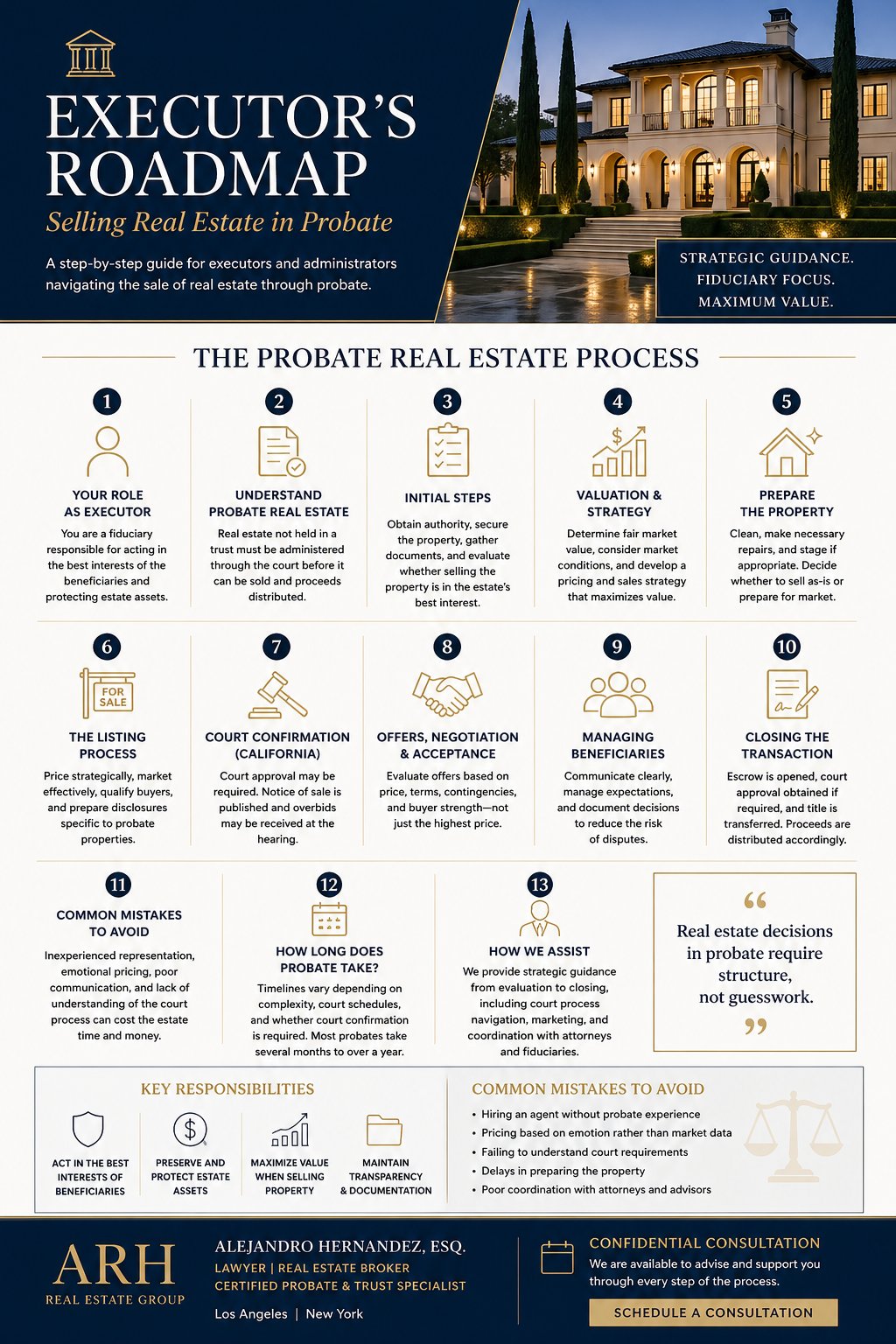
1. YOUR ROLE AS EXECUTOR
As executor or administrator, you are a fiduciary.
This means you are legally required to:
- Act in the best interests of beneficiaries
- Preserve and protect estate assets
- Maximize value when selling property
- Maintain transparency and proper documentation
Real estate decisions are often the most significant financial actions taken during probate.
2. UNDERSTANDING PROBATE REAL ESTATE
Probate real estate refers to property that must be transferred or sold under court supervision.
This typically occurs when:
- A property is not held in a trust
- The estate requires liquidation to distribute assets
- There are debts or obligations to satisfy
Unlike traditional sales, probate transactions involve additional legal steps and oversight.
3. INITIAL STEPS
Before listing a property, several steps must be completed:
- Confirm appointment as executor or administrator
- Obtain authority from the court (full or limited)
- Secure and maintain the property
- Gather relevant documents (title, mortgage, tax records)
- Evaluate whether the property should be sold
Early decisions can impact timing, value, and legal compliance.
4. VALUATION & STRATEGY
Determining the right value is critical.
Executors must consider:
- Fair market value at date of death
- Current market conditions
- Property condition and needed improvements
- Whether to sell “as-is” or prepare for market
Overpricing can delay the estate.
Underpricing can expose the executor to liability.
A structured pricing strategy is essential.
5. PREPARING THE PROPERTY
Before listing, the property may require:
- Cleaning and clearing personal belongings
- Repairs or deferred maintenance
- Professional staging (in some cases)
- Securing insurance coverage
Not all properties should be renovated.
Strategic preparation depends on the estate’s goals and timeline.
6. THE LISTING PROCESS
Once ready, the property is listed for sale.
This includes:
- Pricing strategy
- Marketing approach
- Buyer qualification
- Disclosure preparation
In probate, disclosures differ from traditional sales and must reflect limited knowledge where applicable.
7. COURT CONFIRMATION (CALIFORNIA)
Some probate sales require court confirmation.
This process may involve:
- Accepting an offer subject to court approval
- Publishing a Notice of Sale
- Attending a court hearing
- Allowing overbids from other buyers
This creates an auction-like environment.
Proper handling of this process is critical to avoid delays or failed transactions.
8. OFFERS, NEGOTIATION & ACCEPTANCE
Executors must evaluate offers carefully.
Key considerations:
- Purchase price
- Buyer qualifications
- Contingencies
- Timeline
The highest offer is not always the best offer.
Decisions must align with fiduciary obligations and estate objectives.
9. MANAGING BENEFICIARIES
Probate often involves multiple beneficiaries.
Challenges may include:
- Disagreements over pricing or timing
- Emotional attachment to the property
- Communication breakdowns
Clear communication and structured decision-making help reduce conflict.
10. CLOSING THE TRANSACTION
Once a buyer is secured:
- Escrow is opened
- Required documentation is completed
- Court approval (if required) is finalized
- Title is transferred
Proceeds are then distributed according to the estate plan and court directives.
11. COMMON MISTAKES TO AVOID
Executors frequently encounter issues such as:
- Hiring an agent without probate experience
- Pricing based on emotion rather than market data
- Failing to understand court requirements
- Delays in preparing the property
- Poor coordination with attorneys and advisors
These mistakes can cost the estate time and money.
12. HOW LONG DOES PROBATE TAKE?
Timelines vary depending on:
- Complexity of the estate
- Court schedules
- Whether the sale requires confirmation
- Beneficiary cooperation
Most probate processes take several months to over a year.
Real estate sales are often one of the most time-sensitive components.
13. HOW WE ASSIST
ARH Real Estate Group provides structured advisory throughout the process.
We assist with:
- Property valuation and strategy
- Court process guidance
- Property preparation and positioning
- Marketing and buyer strategy
- Transaction management
- Coordination with attorneys and fiduciaries
Our approach is designed to protect the executor while maximizing estate value.
FINAL THOUGHT
Selling real estate in probate is not simply a transaction.
It is a process that requires:
- Legal awareness
- Strategic decision-making
- Careful execution
Having the right advisory team in place can significantly impact the outcome.
CONFIDENTIAL CONSULTATION
If you are an executor, administrator, or attorney handling a probate property, we are available to assist.
Schedule a confidential consultation to discuss your situation.
ARH Real Estate Group
Los Angeles | New York